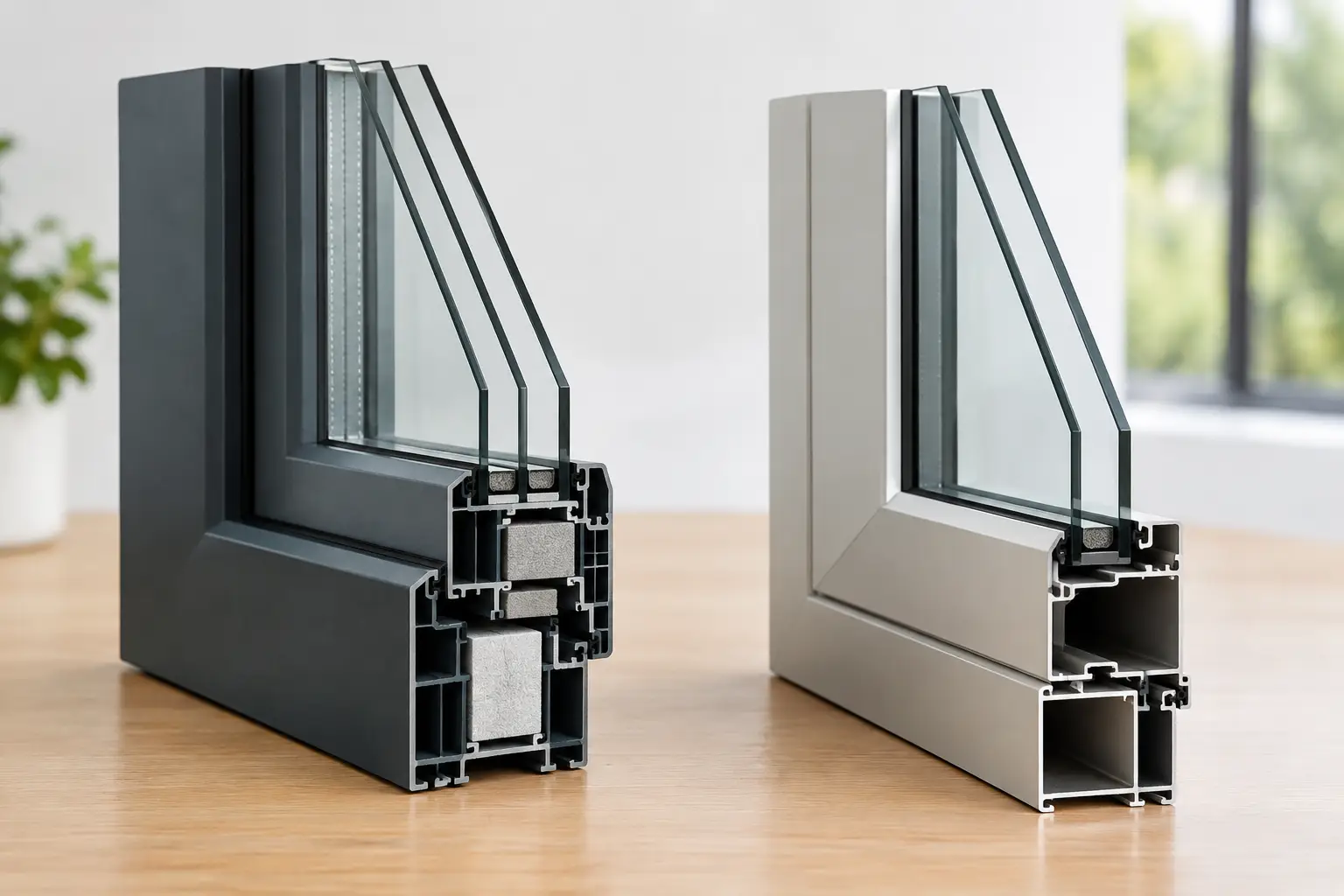
A slim black aluminum frame around a large wall of glass can look exactly right on a contemporary home. But if that frame feels cold on a January morning, the design decision quickly becomes a comfort issue. Do aluminum windows conduct heat? Yes. Aluminum is a highly conductive metal, so an uninsulated aluminum frame can move heat out of a heated home and bring exterior cold toward the interior surface.
That fact does not make aluminum a poor choice for premium residential projects. It means the system specification matters. A properly engineered architectural aluminum window uses a thermal break, insulated glazing, high-quality seals, and precise installation to control heat flow. The difference between basic aluminum and a high-performance European-format aluminum system is substantial.
Do Aluminum Windows Conduct Heat More Than PVC-U?
Aluminum conducts heat far more readily than PVC-U, wood, or fibreglass. In a conventional aluminum frame, the metal creates a direct path between outdoor and indoor conditions. During a Southern Ontario winter, indoor heat can travel through that path toward the colder exterior. In summer, solar-heated exterior aluminum can transfer warmth inward.
The practical consequences are easy to recognize in lower-grade systems: cold frame surfaces, perimeter condensation, uncomfortable radiant chill near the window, and higher demand on the heating and cooling system. Glass is often blamed, but the frame and edge of glass can be the weak point in an under-specified opening.
PVC-U profiles naturally resist heat transfer because plastic is not highly conductive. This is one reason premium multi-chamber PVC-U windows from systems such as VEKA and Kömmerling can deliver excellent thermal performance at a more accessible price point. Their deeper profiles and insulated chambers help reduce heat loss without relying on a metal separator.
However, material conductivity is not the whole performance story. Aluminum has exceptional structural strength, dimensional stability, and a crisp, narrow visual profile. It can support wider spans, taller panels, and more demanding configurations than many conventional window materials. For large-format fixed glazing, lift-and-slide doors, corner openings, and contemporary façades, aluminum may be the right architectural choice, provided the frame is thermally engineered.
The Thermal Break Is What Changes the Equation
A thermal break is a low-conductivity barrier built into the aluminum profile. Most commonly made from reinforced polyamide, it separates the exterior aluminum section from the interior aluminum section. Heat can no longer travel directly through a continuous piece of metal from one side of the frame to the other.
This is not a decorative detail. It is the central performance feature in an insulated aluminum window. Better systems use deeper, carefully designed thermal-break zones, insulated profile chambers, and internal gaskets that limit convection within the frame. The result is a warmer interior frame surface and significantly lower heat transfer than non-thermally broken aluminum.
Not all thermal breaks perform equally. A shallow break in an entry-level frame is not comparable to a high-performance architectural system designed for Canadian heating loads. Frame depth, thermal-break geometry, gasket design, drainage strategy, reinforcement, and the connection between sash and frame all influence the finished result.
For homeowners, the useful question is not simply, “Is it aluminum?” It is, “What is the complete system performance?” Premium aluminum platforms associated with Aluprof, Reynaers, and Schüco are designed as integrated assemblies. Their thermal performance comes from the entire frame, sash, glazing, hardware, and seal package working together.
A warmer interior surface matters
The goal is not only to reduce energy use. A warmer interior frame is more comfortable when you sit near the window, especially beside panoramic glazing in a living room, kitchen, or primary suite. It also lowers the likelihood that humid indoor air will reach its dew point on the frame or glass edge.
Condensation is often misunderstood as a window defect. In reality, it occurs when warm, moisture-laden indoor air contacts a sufficiently cold surface. Better-insulated frames and glass packages raise interior surface temperatures, while appropriate indoor humidity management further reduces risk. This is particularly relevant in new, tightly built homes where moisture generated by cooking, bathing, and everyday living has fewer paths to escape.
Glass Usually Has a Bigger Role Than Homeowners Expect
A window’s glass area is much larger than its frame area, so the insulated glass unit has an enormous effect on overall performance. Even an excellent thermally broken aluminum frame will not deliver its potential with a basic double-pane glass package.
For premium residential applications, triple-pane insulated glass is often the stronger choice. A typical high-performance unit combines three panes of glass with argon-filled cavities, Low-E coatings, and warm-edge spacer technology. The Low-E coating reflects interior heat back into the room during winter while helping manage solar gain. Argon slows heat transfer within the sealed cavities. Warm-edge spacers reduce heat loss at the perimeter, where the glass meets the frame.
The exact package should suit the elevation and the room. A south-facing façade with extensive glazing may need a different solar heat gain strategy than a shaded north elevation. In some projects, maximizing winter solar gain is useful. In others, controlling summer overheating and glare matters more. Large glass areas are never a one-specification decision.
When comparing quotes, ask for the whole-window U-factor rather than relying on centre-of-glass numbers. Centre-of-glass performance excludes the frame, spacer, and edge conditions that influence real-world comfort. A whole-window value is the more honest measure of how the completed unit performs.
Frame Design, Air Seals, and Installation Are Connected
Heat transfer is only one way a window can lose performance. Air leakage around operable sashes or at the perimeter of the installed frame can make a room feel drafty even when the glass itself is high quality. High-performance aluminum systems use multiple compression seals and refined European hardware to create consistent closing pressure around the sash.
Installation is equally critical. A premium frame can be undermined by an uninsulated perimeter gap, poor air-sealing, improper shimming, or an exterior water-management detail that does not suit the wall assembly. Oversized units add another layer of complexity because their weight, movement, and structural load must be properly managed.
For renovations, the existing opening needs careful assessment. The condition of the surrounding framing, the depth of the wall, exterior cladding details, and interior finishing all affect how the new unit can be integrated. For custom builds, window and door selections should be coordinated early with the architect, builder, and mechanical design. That is especially true for large sliding systems and floor-to-ceiling glazing, where structure and envelope detailing need to support the visual intent.
When Aluminum Is the Right Choice
Thermally broken aluminum is particularly compelling when architecture calls for narrow sightlines, dark exterior finishes, oversized openings, or large moving panels. Its stiffness allows for more glass and less visual interruption, creating the expansive views many contemporary homes are designed around.
It is also a strong option where long-term finish quality and dimensional stability matter. Aluminum does not swell, rot, or become brittle in the way some materials can under prolonged exposure. Powder-coated architectural finishes offer durable colour options, including the deep charcoal and black tones popular in modern residential design.
The trade-off is cost. High-performance aluminum typically costs more than premium PVC-U, and large-format systems require more specialized engineering and installation. For a standard bedroom window where maximum thermal value is the priority, a quality triple-pane PVC-U system may be the more efficient investment. For a dramatic rear elevation with wide glass panels and minimal frame lines, insulated aluminum can justify its premium.
Questions worth asking before specifying aluminum
Ask whether the system has a true polyamide thermal break, what the whole-window U-factor is with the proposed glass, and whether triple-pane glazing is available in the required size. Confirm the air and water performance ratings, the spacer type, and how the frame will be insulated and sealed at installation.
For sliding doors, also ask about panel weight capacity, sill drainage, threshold design, and hardware adjustment. A panoramic system should feel precise and secure, not merely look impressive on a rendering.
The Better Question Is How the Window Is Built
Aluminum on its own conducts heat quickly. High-performance aluminum windows address that limitation through thermal separation, advanced glazing, tight seals, and installation that respects the building envelope. The finished system can provide the slim profiles and structural capability needed for ambitious residential glazing without accepting the cold frames associated with older aluminum windows.
For a home that needs more daylight, wider openings, and a refined architectural façade, material choice should follow the project rather than a rule of thumb. Specify the frame, glass, and installation as one complete performance package, and the view will feel as good in February as it looks in July.